
Closing the Loop on Compostable Packaging

End-to-End EPR Compliance & Credit Management by Bambrew
Extended Producer Responsibility (EPR) is no longer optional for brands operating in India. It is a regulatory mandate under the Plastic Waste Management Rules, 2016.
Yet for many brands, compliance remains fragmented, reactive, and complex.
Most companies focus on sourcing sustainable packaging. Very few manage what happens after the packaging is used.
At Bambrew, we believe sustainability does not end at supply. It ends at recovery, processing, and compliant credit closure.
This is how we help brands close the loop.
The EPR Reality: What Brands Are Up Against
Under India’s EPR framework, Producers, Importers, and Brand Owners (PIBOs) must:
Meet mandatory EPR targets
Fulfil category-specific recovery obligations
Upload verified data on the CPCB portal
Maintain traceable documentation
Avoid penalties and regulatory exposure
The challenge?
Portal reporting complexity
Lack of end-of-life traceability
Difficulty in managing post-consumer waste
Confusion around category alignment
Most brands buy packaging. Few manage its end-of-life responsibly.
That is where structured compliance becomes critical.
Understanding EPR Categories
Plastic packaging under Indian regulations is divided into four categories:
Category I – Flexible plastic packaging
Category II – Rigid plastic packaging
Category III – Multilayered plastics / energy recovery
Category IV – Compostable plastics (CPCB certified)
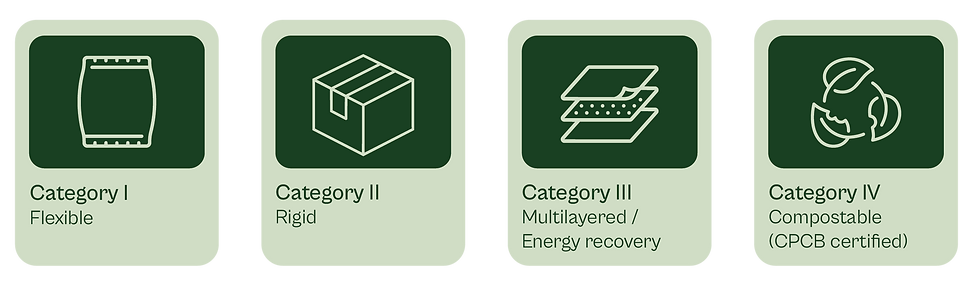
Compostable packaging falls under Category IV, provided it is certified by the Central Pollution Control Board (CPCB).
Each category carries separate compliance obligations. Importantly, credits cannot be interchanged across categories except as permitted under specific regulatory clauses.
Which means strategy matters.
The Waste Streams Brands Generate
To design a strong EPR plan, brands must understand the type of waste they generate:
PIR – Post-Industrial Waste
Internal plant waste
High traceability
Higher recovery efficiency
Easier documentation
PCR – Post-Consumer Waste
Market-generated waste
Harder to track
Requires structured collection systems
Needs verified processing partners
Most compliance gaps arise from poor PCR management.
Without a structured collection and processing model, traceability weakens and compliance confidence reduces.
Bambrew’s Closed-Loop Compliance Model
We do not stop at supplying compostable packaging. We ensure the material is recovered and credited correctly.
Our model:
Plant / Market
↓
Bambrew Collection Network
↓ Authorized Processor ↓
Industrial Composting / Energy Recovery ↓ EPR Portal Credit Upload ↓
Obligation Adjustment
This ensures:
Traceable material movement
Verified processing documentation
Accurate credit generation
Category-aligned portal reporting
We do not just supply sustainable material.
We close the compliance loop.
Category III & IV: Credit Strategy Done Right
One of the most misunderstood areas in EPR compliance is credit categorization.
Best Practice
Generate Category IV credits when compostable waste is processed through certified composting systems.
Complex Scenario
If compostable waste is processed through energy recovery, portal classification may reflect it under Category III.
Under Clause 8 of the Plastic Waste Management Rules, 2016:
Surplus credits can be carried forward
They can offset previous shortfalls
They can be sold to other eligible entities
Category surpluses can only offset within the same category, with specific exceptions
The CPCB has also introduced the EPR Exchange mechanism via its centralized portal to enable transparent trading of surplus certificates.
This is where strategic credit management becomes essential.
At Bambrew, we ensure:
Category-aligned credit optimization
Portal-compliant reporting
Structured documentation
Zero regulatory exposure
Compliance is not just about generating credits. It is about generating the right credits.
The Role of the CPCB Exchange Portal
The Central Pollution Control Board has launched an EPR Exchange Portal to facilitate transparent trading of surplus EPR certificates.
This mechanism enables:
Structured linkage between entities with surplus credits
Brands facing compliance gaps
Recorded and auditable transactions
Centralized reporting under annual EPR filings
For brands, this creates flexibility, but only if credits are correctly categorized and documented.
Why Closing the Loop Matters
When compliance is fragmented, risk increases.
When recovery is unverified, exposure grows.
An integrated model delivers:
Reduced compliance risk
Full material traceability
Audit-ready documentation
ESG and sustainability reporting support
Single-point accountability

Bambrew = Material + Recovery + Compliance
Sustainable packaging is step one.
Regulatory closure is step two.
The future of responsible packaging lies in integrating both.
At Bambrew, we help brands move beyond procurement towards measurable, auditable, end-to-end compliance.
Because true sustainability does not end at delivery. It ends when the loop is closed.


Comments